How North Korean Hackers are Impacting Hiring
The largest cryptocurrency heist of all time took place via a recruitment process: on 29 October, $6.3bn was stolen from Binance using fake job interviews.

Co-founder · · 9 min read
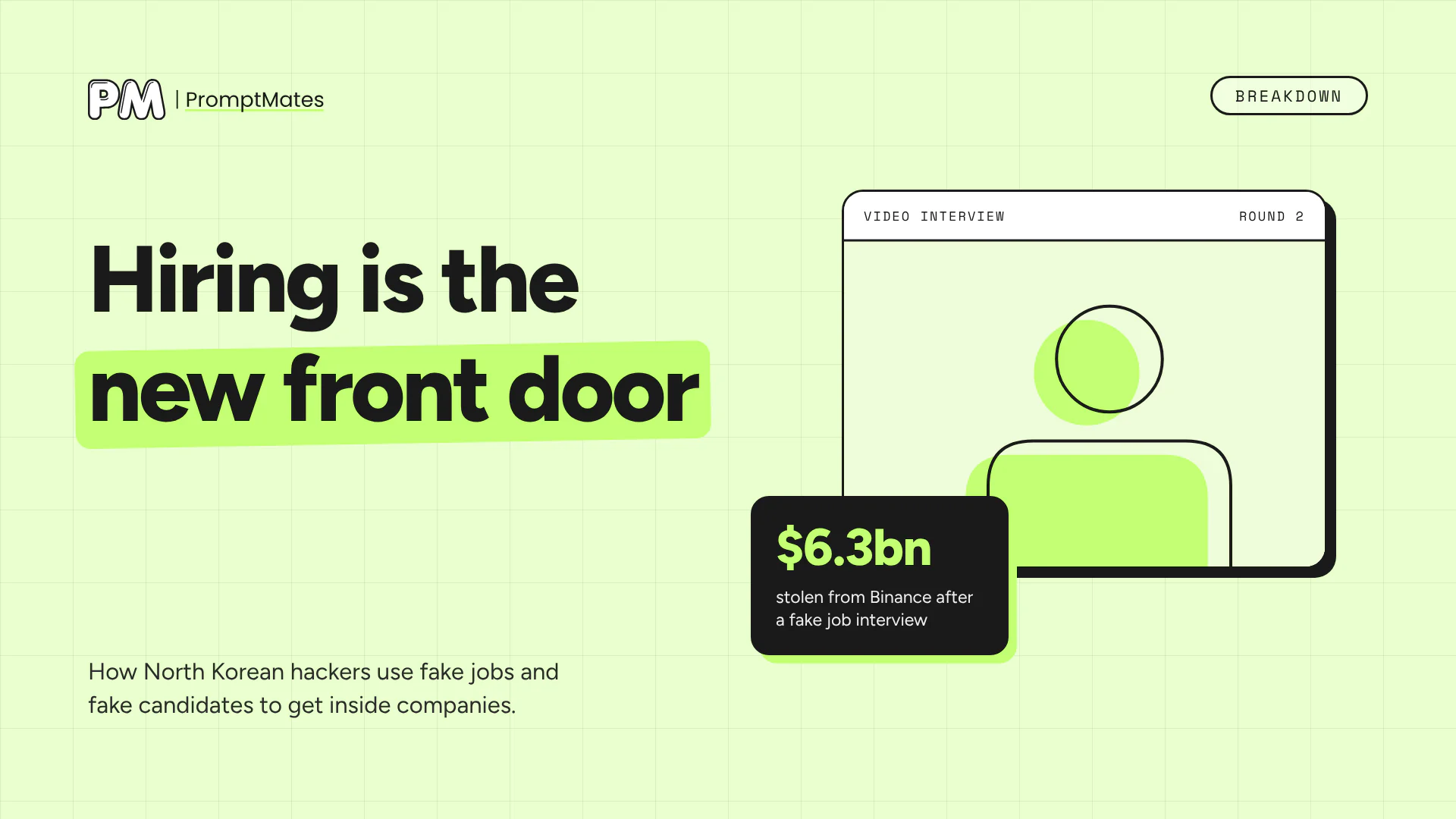
On 29 October, $6.3bn of digital currency was stolen from cryptocurrency exchange Binance using fake job interviews.
Whilst it may surprise some that the largest cryptocurrency heist of all time took place via a recruitment process, for many talent acquisition and HR leaders, dealing with bad actors has become an increasingly regular occurrence.
TOFU reported 14% of their clients have already hired a North Korean IT worker (opens in a new tab). Whilst thinking about government-backed hackers might feel like an abstract concept, this is perhaps the single biggest threat for hiring leaders to understand.
We discussed this on PromptMates Live along with Luke Eaton (Ava Labs) and Evan Palmer (Harmonic), who shared their first-hand experience dealing with hiring fraud (watch the full discussion here (opens in a new tab)).
The bigger picture: Why is this happening?
Gordon Corera (former BBC security correspondent) and David McCloskey (former CIA analyst) provided a breakdown on The Rest Is Classified (opens in a new tab) of how widespread this programme is.
A key distinction they made was that this is not a small group of hackers operating on the margins of North Korean society. They describe a state that organises cybercrime as a major revenue-generating activity, using its intelligence apparatus to steal money and support the regime.
Official reporting backs this up, and the Multilateral Sanctions Monitoring Team’s October 2025 report (opens in a new tab) describes a national cyber programme whose specialised units are resourced, trained and deployed by North Korea’s military and party apparatus. It places cybercrime and IT work within state funding structures, rather than outside them.
Behind it is a talent pipeline. In May 2023, the US Treasury identified Pyongyang University of Automation (opens in a new tab) as a training institution for malicious cyber actors, many of whom enter units subordinate to the Reconnaissance General Bureau, North Korea’s principal intelligence bureau. The monitoring team also describes Moranbong University sending graduates into RGB cyber units.
Hiring processes are a core target area for these cyber actors to attack overseas companies via both fake jobs and fake workers.
The Binance Hack: How a fake job led to a $6bn theft
North Korea-linked crypto theft has been climbing year over year. Chainalysis (opens in a new tab) put it at $1.3bn in 2024, which included $308m from a fake LinkedIn recruiter who compromised a supplier's employee. In 2025 it was over $2bn (opens in a new tab), driven by the $1.5bn Bybit hack. So far in 2026, TRM Labs (opens in a new tab) puts it at around $7.4bn, mostly from a single attack, $6.3bn from Binance, where a fake job interview helped the hackers get in.
Reuters (opens in a new tab) reconstructed a timeline from Binance's own investigation (opens in a new tab):
- June: An engineer on Binance's wallet team downloaded a developer tool that had been tampered with. Binance spotted the problem and replaced the device, but the attackers had learned who worked on that team.
- September: A second engineer on the same team was approached through a legitimate jobs platform by a "recruiter" from a company that looked convincing.
- September / October: He had a video interview with the supposed recruiter, then a further round with the company's supposed CEO.
- September / October: He was sent an interview task to download and run. He ran it on his work computer, and it installed malicious code.
- 20 October: The attackers used that access to reach the systems that control Binance's wallets.
- 29 October: About $6.3bn was drained and quickly spread across thousands of wallets. The FBI (opens in a new tab) has attributed the theft to North Korea, which denies it.
Posing as an employer is one of North Korea's most established tactics, and Microsoft (opens in a new tab), ESET and the multilateral sanctions monitors (opens in a new tab) have all documented it.
The hackers target people who already work somewhere valuable, such as engineers at crypto firms, defence companies and software suppliers. They offer an attractive role, run a process that feels like the real thing, and at some point ask the candidate to open a file, run a coding test or install meeting software.
This has worked before, too. In 2022 a fake job offer reportedly gave hackers a way into Ronin (opens in a new tab), the blockchain behind the game Axie Infinity, at a cost of around $600m. In 2024 a fake LinkedIn recruiter's "pre-interview test" got them into a supplier to Japan's DMM Bitcoin (opens in a new tab), which lost $308m.
It works because the jobs platform is genuine, the interviewers are convincing, and take-home tasks are routine in tech hiring.
A technical deep dive (opens in a new tab) explains more about how these attacks are run, including mitigation and protection advice for technical and HR leaders, such as keeping interviews away from work systems, making malware harder to run by limiting scripting tools, using short-lived credentials and rotating credentials quickly when something is flagged.
Guidance from LinkedIn (opens in a new tab) and the UK's Recruitment and Employment Confederation (REC) (opens in a new tab) suggests recruiters can support this by publishing online credentials, running safe assessments in controlled environments and helping candidates identify and report fraud.
How Fake Candidates Earn North Korea up to $800m a Year
The second way North Korea exploits hiring turns the Binance attack on its head. This time the job is real, and the candidate is fake. According to the US Treasury (opens in a new tab), North Korea sends thousands of IT workers abroad to apply for remote tech jobs using stolen or borrowed identities.
The multilateral sanctions monitoring team (opens in a new tab) estimated in September 2026 that North Korea's overseas workers generated $450m–$800m in 2025, most of it from IT workers, and US investigators say (opens in a new tab) the regime keeps around 90% of what they earn. CrowdStrike (opens in a new tab) monitored these workers infiltrating more than 320 companies in a single year, a 220% increase.
Although this has been more widespread in the USA, Google's threat intelligence team (opens in a new tab) has reported the scheme spreading into Europe. The UK's Office of Financial Sanctions Implementation (opens in a new tab) has warned British employers that hiring these workers, even unknowingly, can breach sanctions.
The clearest example is Christina Chapman, an Arizona woman who was sentenced in 2025 to more than eight years in prison. According to the US Justice Department (opens in a new tab), she helped North Korean workers get jobs at 309 US companies using 68 stolen identities, bringing in more than $17m.
Even companies that specialise in security have been caught out. KnowBe4 (opens in a new tab) ran four video interviews and background checks before hiring a software engineer who turned out to be a North Korean worker using a stolen US identity and an AI-edited photo. By the company's own account, the worker was caught only when malware appeared on the new starter's laptop.
How it works
Workers use stolen or rented identities, and an October 2026 advisory (opens in a new tab) says they increasingly pay people to lend them established LinkedIn profiles that look credible to recruiters.
AI-edited photos and polished CVs help them pass the early hiring stages, and investigators report (opens in a new tab) that some pay stand-ins to take interviews for them.
Once hired, they need to look local. Helpers in the target country (like Chapman) receive the company laptop and keep it online, so the employer thinks the worker is at home when they're really logging in from abroad.
The salary then flows through intermediaries and frequently changing accounts, and most of it ends up with the state. For some workers, the job is also a way into company systems. Investigators warn that some steal code or data and threaten to leak it once they're found out.
What employers can do
On the show, Luke and Evan kept returning to the same point: no single check catches a fake candidate, but a few joined-up habits catch a lot. Here's their advice, plus a few points from Luke’s Hiring Safety Playbook (opens in a new tab) (worth a bookmark).
1. Spot the fake candidate
Look past the profile. A strong GitHub and social presence is not proof. Evan's candidate passed a recruiter screen until a blurred background dropped mid-call (opens in a new tab) to reveal a room of people on headsets.
Ask what only the real person could answer. Standard questions are easy to script, including with AI. Do the homework first. Evan found a blog post a candidate had supposedly written, and when asked about it they hung up, citing Wi-Fi. Luke's playbook adds the human questions, like hometown, local weather and what's outside the window, where scripted answers tend to wobble.
Follow the money and the kit. Luke recommends checking payment details against US Treasury lists (opens in a new tab) of North Korea-linked accounts, because a match is a hard signal. Verify ID before the offer and again on day one, pay only into an account in the employee's own name, and ship equipment only to the verified address. That's the FBI's "identity in depth (opens in a new tab)" in practice.
2. Protect your people from fake jobs
Publish what genuine hiring looks like. Luke's fix for fake recruiters is a short public "trust stack": named recruiters with LinkedIn links, one recruiting email domain, the tools you actually use, your agency policy, and a clear "never" list (opens in a new tab) (e.g. we will never ask you to install software, run a command, download a file to join an interview, or pay anything).
Keep interview code off work machines. Use hosted environments for take-homes and sandboxes for technical interviews, so your own process never looks like a scam.
Know what to do if someone has already run something. Luke's playbook says to loop in IT straight away, take the device offline, and change any passwords or tokens it could reach from a clean machine. Keep the evidence, report it (Action Fraud in the UK, the FBI's IC3 in the US), then wipe the device and check what else it could reach. At Binance, the attackers spread from one laptop to colleagues'.
Make it everyone's job. Evan's point was that this belongs in company-wide security training, not just with talent or security. Staff with production, finance or payment access are the targets, so make it normal to say "a recruiter just messaged me".
3. Stay fair, and escalate rather than confront
A red flag isn't evidence on its own. Luke flagged neurodivergent candidates, who may simply communicate differently, and nationality, accent or remote working are not evidence of fraud either. Review concerns fairly, and involve security and legal before confronting anyone, because discovery can lead to threats or extortion (FBI (opens in a new tab)).
Conclusion
Behind the convincing CVs and the one wrong file is a state-level revenue programme that uses hiring as a front door. Fake jobs to reach people already inside a business, and fake candidates to get inside one.
That means TA and HR leaders now own part of security, alongside IT, legal and hiring managers. Recruiters don't need to become cyber investigators, but they do see parts of the process that nobody else does. As Luke and Evan showed, joining those pieces up matters more than adding another isolated check, and it can be done without making hiring harder for genuine people.
Watch the full show (opens in a new tab).
This article is for general awareness and isn't legal or sanctions advice. UK employers should read OFSI's guidance on North Korean IT workers (opens in a new tab).
Further reading
- Luke's Hiring Safety Playbook (opens in a new tab)
- TOFU's candidate fraud guide (opens in a new tab)
- How DPRK Hackers Perfected Their Fake Interview Playbook Before Binance (opens in a new tab)
- Greenhouse's guidance for recruiters (opens in a new tab)
- Google and Mandiant's mitigation guide (opens in a new tab)
- OFSI's advisory (opens in a new tab)